Because of you…

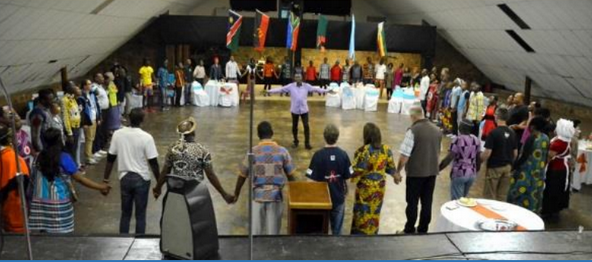
South Africa is one of the largest Youth for Christ national programs. Their current ministries include AIDS awareness and abstinence programs, follow-up counseling services, music and drama team ministries in schools, shelters for former street children, juvenile prison ministry, gender equality/women’s empowerment projects, life skills and job skills workshops, youth leadership development conferences, and teen pregnancy centers.

Prayer Needs

  • Wisdom and strength in pioneering new Youth for Christ centres in South Africa.
  • Pray that young people will be come followers of Christ in large numbers.
  • Continued godly guidance and effectiveness as the staff and volunteers work with programs in schools, especially the HIV/AIDS awareness program.
  • Increased spiritual growth for the growing staff as they minister and work with young people in prison and with homeless children.
  • Unity and godly focus of the church.
  • The government as it tackles crime, unemployment, education and health issues.

About South Africa

South Africa

Introduction

Dutch traders landed at the southern tip of modern day South Africa in 1652 and established a stopover point on the spice route between the Netherlands and the Far East, founding the city of Cape Town. After the British seized the Cape of Good Hope area in 1806, many of the Dutch settlers (the Boers) trekked north to found their own republics. The discovery of diamonds (1867) and gold (1886) spurred wealth and immigration and intensified the subjugation of the native inhabitants. The Boers resisted British encroachments but were defeated in the Boer War (1899-1902); however, the British and the Afrikaners, as the Boers became known, ruled together beginning in 1910 under the Union of South Africa, which became a republic in 1961 after a whites-only referendum. In 1948, the National Party was voted into power and instituted a policy of apartheid - the separate development of the races - which favored the white minority at the expense of the black majority. The African National Congress (ANC) led the opposition to apartheid and many top ANC leaders, such as Nelson MANDELA, spent decades in South Africa's prisons. Internal protests and insurgency, as well as boycotts by some Western nations and institutions, led to the regime's eventual willingness to negotiate a peaceful transition to majority rule. The first multi-racial elections in 1994 brought an end to apartheid and ushered in majority rule under an ANC-led government. South Africa since then has struggled to address apartheid-era imbalances in decent housing, education, and health care. ANC infighting, which has grown in recent years, came to a head in September 2008 when President Thabo MBEKI resigned, and Kgalema MOTLANTHE, the party's General-Secretary, succeeded him as interim president. Jacob ZUMA became president after the ANC won general elections in April 2009.

Geography

Location

Location: Southern Africa, at the southern tip of the continent of Africa
Geographic Coordinates: 29 00 S, 24 00 E

Area

Total Area: 1,219,090 sq km Rank: 25
Land Area: 1,214,470 sq km
Water Area: 4,620 sq km
Note: includes Prince Edward Islands (Marion Island and Prince Edward Island)
Comparison: slightly less than twice the size of Texas
Land Boundaries: 4,862 km
Bordering Countries: Botswana 1,840 km, Lesotho 909 km, Mozambique 491 km, Namibia 967 km, Swaziland 430 km, Zimbabwe 225 km
Coastline: 2,798 km

Climate

mostly semiarid; subtropical along east coast; sunny days, cool nights

Terrain

vast interior plateau rimmed by rugged hills and narrow coastal plain

Elevations

Lowest Point: Atlantic Ocean 0 m
Highest Point: Njesuthi 3,408 m

Natural Resources

gold, chromium, antimony, coal, iron ore, manganese, nickel, phosphates, tin, uranium, gem diamonds, platinum, copper, vanadium, salt, natural gas

Land Use

Arable land: 12.1%
Permanent Crops: 0.79%
Other: 87.11% (2005)
Irrigated Land: 14,980 sq km (2003)
Renewable Water Resources: 50 cu km (1990)
Total Freshwater withdrawal (domestic/industrial/agricultural): 12.5 cu km/yr (31%/6%/63%)
Freshwater Withdrawal Per Capita: 264 cu m/yr (2000)

Environment

Natural Hazards: prolonged droughts
Environmental Issues: lack of important arterial rivers or lakes requires extensive water conservation and control measures; growth in water usage outpacing supply; pollution of rivers from agricultural runoff and urban discharge; air pollution resulting in acid rain; soil erosion; desertification
Environmental Agreements: Party to: Antarctic-Environmental Protocol, Antarctic-Marine Living Resources, Antarctic Seals, Antarctic Treaty, Biodiversity, Climate Change, Climate Change-Kyoto Protocol, Desertification, Endangered Species, Hazardous Wastes, Law of the Sea, Marine Dumping, Marine Life Conservation, Ozone Layer Protection, Ship Pollution, Wetlands, Whaling

Geography Notes

South Africa completely surrounds Lesotho and almost completely surrounds Swaziland

People

Population: 49,052,489 Rank: 24
Note: estimates for this country explicitly take into account the effects of excess mortality due to AIDS; this can result in lower life expectancy, higher infant mortality, higher death rates, lower population growth rates, and changes in the distribution of population by age and sex than would otherwise be expected (July 2010 est.)

Age Structure

0-14 years: 28.9% (male 7,093,328/female 7,061,579)
15-64 years: 65.8% (male 16,275,424/female 15,984,181)
65 years and over: 5.4% (male 1,075,117/female 1,562,860) (2010 est.)
Median Age: 24.4 years

Population Growth

Growth Rate: 0.281% (2010 est.) Rank: 174
Birth Rate: 19.93 births/1,000 population (2010 est.) Rank: 99
Death Rate: 16.99 deaths/1,000 population (July 2010 est.) Rank: 8
Net Migration Rate: -0.13 migrant(s)/1,000 population Rank: 93
Note: there is an increasing flow of Zimbabweans into South Africa and Botswana in search of better economic opportunities (2010 est.)

Urbanization

Urban Population: 61% of total population (2008)
Rate of Urbanization: 1.4% annual rate of change (2005-10 est.)

Life and Death

Infant Mortality Rate: 44.42 deaths/1,000 live births Rank: 61
Life Expectancy at Birth: 48.98 years Rank: 212
Fertility Rate: 2.33 children born/woman (2010 est.) Rank: 104

Health and Disease

HIV/AIDS - Adult Prevalence Rate: 18.1% (2007 est.) Rank: 4
People living with HIV/AIDS: 5.7 million (2007 est.) Rank: 2
HIV/AIDS Deaths: 350,000 (2007 est.) Rank: 1
Degree of Risk for Major Infectious Diseases: intermediate
Food or waterborne diseases: bacterial diarrhea, hepatitis A, and typhoid fever
Water Contact Diseases: schistosomiasis (2009)

Nationality and Culture

Noun: South African(s)
Adjective: South African
Ethnic Groups: black African 79%, white 9.6%, colored 8.9%, Indian/Asian 2.5% (2001 census)
Religion: Zion Christian 11.1%, Pentecostal/Charismatic 8.2%, Catholic 7.1%, Methodist 6.8%, Dutch Reformed 6.7%, Anglican 3.8%, Muslim 1.5%, other Christian 36%, other 2.3%, unspecified 1.4%, none 15.1% (2001 census)
Languages: IsiZulu 23.8%, IsiXhosa 17.6%, Afrikaans 13.3%, Sepedi 9.4%, English 8.2%, Setswana 8.2%, Sesotho 7.9%, Xitsonga 4.4%, other 7.2% (2001 census)

Education

Literacy (Meaning, age 15 and over can read and write): 86.4% Male: 87% Female: 85.7% (2003 est.)
School life expectancy (primary to tertiary education): 13 years Male: 13 years Female: 13 years (2004)
Education expenditures: 5.4% of GDP (2006) Rank: 52

Government

Country Name

Conventional Long Form: Republic of South Africa
Conventional Short Form: South Africa
Formerly: Union of South Africa
Abbreviation: RSA
Government Type: republic
Capital: Pretoria (administrative capital) Geographic Coordinates: 25 42 S, 28 13 E
Note: Cape Town (legislative capital); Bloemfontein (judicial capital)

Administrative divisions

9 provinces; Eastern Cape, Free State, Gauteng, KwaZulu-Natal, Limpopo, Mpumalanga, Northern Cape, North-West, Western Cape
Independence: 31 May 1910 (Union of South Africa formed from four British colonies: Cape Colony, Natal, Transvaal, and Orange Free State); 31 May 1961 (republic declared); 27 April 1994 (majority rule)
National holiday: Freedom Day, 27 April (1994)
Constitution: 10 December 1996; note - certified by the Constitutional Court on 4 December 1996; was signed by then President MANDELA on 10 December 1996; and entered into effect on 4 February 1997
Legal system: based on Roman-Dutch law and English common law; has not accepted compulsory ICJ jurisdiction
Suffrage: 18 years of age; universal

Executive Branch

Chief of State: President Jacob ZUMA (since 9 May 2009); Executive Deputy President Kgalema MOTLANTHE (since 11 May 2009); note - the president is both the chief of state and head of government
Head of Government: President Jacob ZUMA (since 9 May 2009); Executive Deputy President Kgalema MOTLANTHE (since 11 May 2009)
Cabinet: Cabinet appointed by the president
Elections: president elected by the National Assembly for a five-year term (eligible for a second term); election last held on 6 May 2009 (next to be held in 2014)
Election Results: Jacob ZUMA elected president; National Assembly vote - Jacob ZUMA 277, Mvume DANDALA 47, other 76

Legislative Branch

bicameral Parliament consisting of the National Council of Provinces (90 seats; 10 members elected by each of the nine provincial legislatures for five-year terms; has special powers to protect regional interests, including the safeguarding of cultural and linguistic traditions among ethnic minorities) and the National Assembly (400 seats; members elected by popular vote under a system of proportional representation to serve five-year terms)
Elections: National Assembly and National Council of Provinces - last held on 22 April 2009 (next to be held in April 2014)
Election Results: National Council of Provinces - percent of vote by party - NA; seats by party - NA; National Assembly - percent of vote by party - ANC 65.9%, DA 16.7%, COPE 7.4%, IFP 4.6%, other 5.4%; seats by party - ANC 264, DA 67, COPE 30, IFP 18, other 21

Judicial branch

Constitutional Court; Supreme Court of Appeals; High Courts; Magistrate Courts

Politics

Political Parties and Leaders: African Christian Democratic Party or ACDP [Kenneth MESHOE]; African National Congress or ANC [Jacob ZUMA]; Congress of the People or COPE [Mosiuoa LEKOTA]; Democratic Alliance or DA [Helen ZILLE]; Freedom Front Plus or FF+ [Pieter MULDER]; Independent Democrats or ID [Patricia DE LILLE]; Inkatha Freedom Party or IFP [Mangosuthu BUTHELEZI]; Pan-Africanist Congress or PAC [Motsoko PHEKO]; United Christian Democratic Party or UCDP [Lucas MANGOPE]; United Democratic Movement or UDM [Bantu HOLOMISA]
Political pressure groups and leaders: Congress of South African Trade Unions or COSATU [Zwelinzima VAVI, general secretary]; South African Communist Party or SACP [Blade NZIMANDE, general secretary]; South African National Civics Organization or SANCO [Mlungisi HLONGWANE, national president]
Note: note - COSATU and SACP are in a formal alliance with the ANC
International Organization Participation: ACP, AfDB, AU, BIS, C, CD, FAO, FATF, G-20, G-24, G-77, IAEA, IBRD, ICAO, ICC, ICCt, ICRM, IDA, IFAD, IFC, IFRCS, IHO, ILO, IMF, IMO, IMSO, Interpol, IOC, IOM, IPU, ISO, ITSO, ITU, ITUC, MIGA, MONUC, NAM, NSG, OPCW, Paris Club (associate), PCA, SACU, SADC, UN, UNAMID, UNCTAD, UNESCO, UNHCR, UNIDO, UNITAR, UNWTO, UPU, WCO, WFTU, WHO, WIPO, WMO, WTO, ZC
Flag Description: two equal width horizontal bands of red (top) and blue separated by a central green band that splits into a horizontal Y, the arms of which end at the corners of the hoist side; the Y embraces a black isosceles triangle from which the arms are separated by narrow yellow bands; the red and blue bands are separated from the green band and its arms by narrow white stripes; the flag colors do not have any official symbolism, but the Y stands for the "convergence of diverse elements within South African society, taking the road ahead in unity"; black, yellow, and green are found on the flag of the African National Congress, while red, white, and blue are the colors in the flags of the Netherlands and the UK, whose settlers ruled South Africa during the colonial era
Note: the South African flag is the only national flag to display six colors as part of its primary design

Economy

Economy Overview: South Africa is a middle-income, emerging market with an abundant supply of natural resources; well-developed financial, legal, communications, energy, and transport sectors; a stock exchange that is 18th largest in the world; and modern infrastructure supporting an efficient distribution of goods to major urban centers throughout the region. At the end of 2007, South Africa began to experience an electricity crisis. State power supplier Eskom encountered problems with aged plants, necessitating "load-shedding" cuts to residents and businesses in the major cities. Growth was robust from 2004 to 2008 as South Africa reaped the benefits of macroeconomic stability and a global commodities boom, but began to slow in the second half of 2008 due to the global financial crisis' impact on commodity prices and demand. GDP fell nearly 2% in 2009. Unemployment remains high and outdated infrastructure has constrained growth. Daunting economic problems remain from the apartheid era - especially poverty, lack of economic empowerment among the disadvantaged groups, and a shortage of public transportation. South Africa's former economic policy was fiscally conservative, focusing on controlling inflation, and attaining a budget surplus. The current government largely follows the same prudent policies, but must contend with the impact of the global crisis and is facing growing pressure from special interest groups to use state-owned enterprises to deliver basic services to low-income areas and to increase job growth. More than one-quarter of South Africa's population currently receives social grants.

Gross Domestic Product

GDP (purchasing power parity): $505.3 billion (2009 est.) Rank: 26
GDP - real growth rate: -1.8% (2009 est.) Rank: 145
GDP - per capita (PPP): $10,300 (2009 est.) Rank: 104
GDP - Composition by Sector: Agriculture: 3% Industry: 31.1% Services: 65.8% (2009 est.)

Labor Force

Labor Force: 17.38 million economically active (2009 est.) Rank: 35
Labor force - by occupation: Agriculture: 9% Industry: 26% Services: 65% (2007 est.)
Unemployment Rate: 24% (2009 est.) Rank: 172

Poverty

Population below poverty line: 50% (2000 est.)

Transnational Issues

International Disputes: South Africa has placed military along the border to apprehend the thousands of Zimbabweans fleeing economic dysfunction and political persecution; as of January 2007, South Africa also supports large numbers of refugees and asylum seekers from the Democratic Republic of the Congo (33,000), Somalia (20,000), Burundi (6,500), and other states in Africa (26,000); managed dispute with Namibia over the location of the boundary in the Orange River; in 2006, Swazi king advocates resort to ICJ to claim parts of Mpumalanga and KwaZulu-Natal from South Africa
Refugees and internally displaced persons - refugees (country of origin): 10,772 (Democratic Republic of Congo); 7,818 (Somalia); 5,759 (Angola) (2007)

Want to know more? Show Full Profile